If I were to ask most people what causes chronic inflammation, I will get the same three answers: too much sugar, too much stress and not enough sleep. And all these three answers are true, of course. But they are not complete. It´s like blaming a house fire on "bad luck" while ignoring the frayed wiring behind the wall.
The wiring, in this case, is a molecular complex called the NLRP3 inflammasome - your cell's internal smoke detector. In a healthy body it fires when there's a genuine threat, then switches off. In chronic inflammation, something keeps pressing the test button, long after the "threat" has passed. And a surprising amount of what keeps that button pressed has nothing to do with the donut you ate on Tuesday. It's in your cooking oil, your gut lining, your sleep schedule and your water glass.
So, let´s dive it and see what are those hidden inflammation triggers.
Your gut lining is one cell thick
Somewhere between "eat more fiber" and "heal your gut," most people lose the actual mechanism. So here it is: your intestinal wall is a single layer of cells, and its job is to let nutrients through while keeping everything else out. When that barrier loosens - a state researchers call intestinal permeability - a bacterial toxin called lipopolysaccharide (LPS) slips into your bloodstream.
Your immune system reads LPS as an active bacterial invasion and it responds accordingly, whether or not there's an actual infection. This condition, known as metabolic endotoxemia, is now a well-documented contributor to low-grade systemic inflammation, and it doesn't require you to be visibly sick for it to be happening. You can feel completely fine and still be running a background alarm.
The oil in your pantry may be quietly going rancid
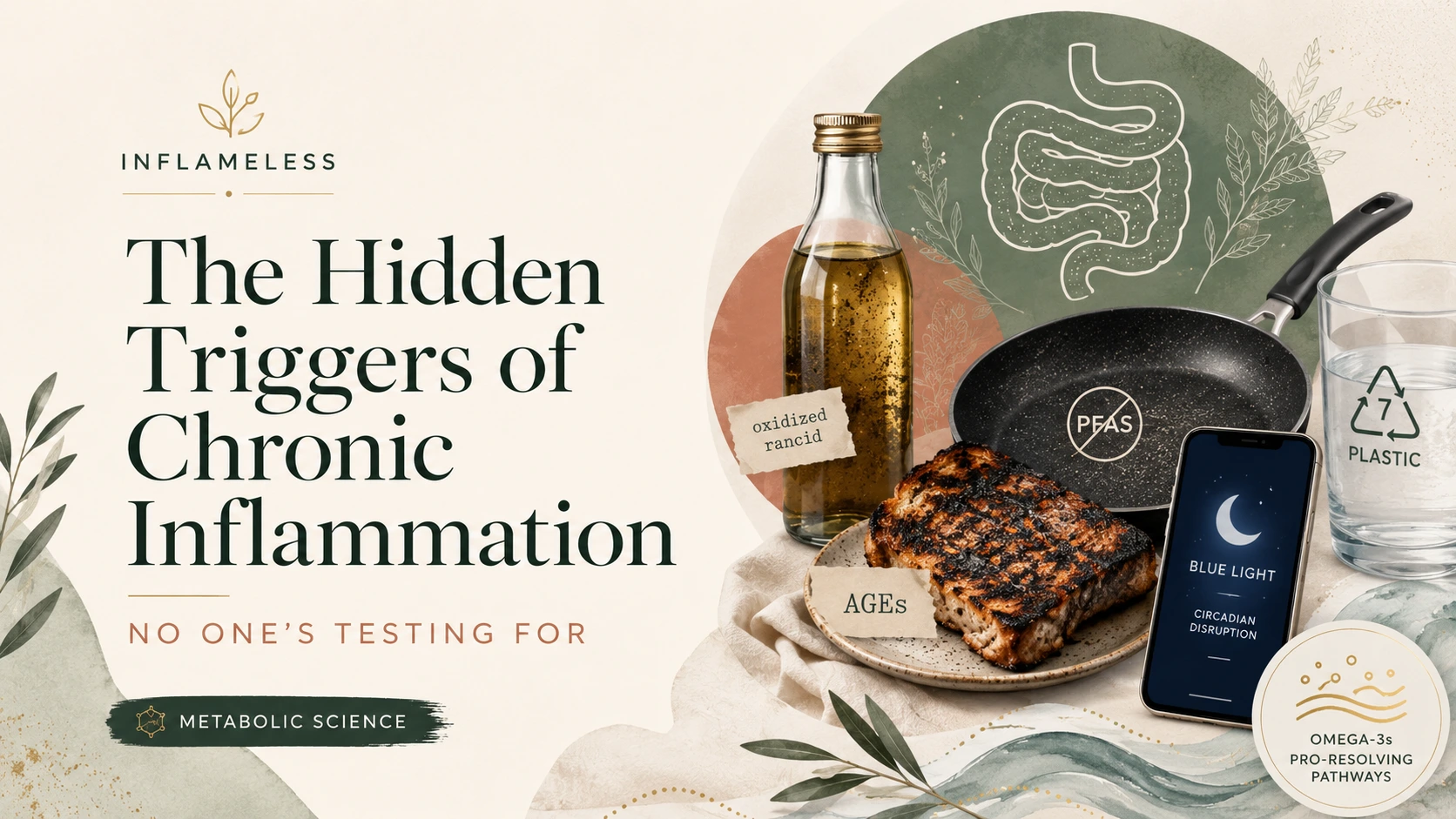
I have to talk about seed oils, because the mechanism here gets skipped even when the ingredient gets blamed. Canola, corn, soy, sunflower, safflower - these are high in linoleic acid, a polyunsaturated fat with several chemically unstable double bonds. Expose that structure to heat, light or air and it oxidizes. It goes rancid, in the same sense butter goes rancid, except you usually can't taste it in a bag of crackers.
Once those oxidized fats integrate into your cell membranes, they behave like faulty wiring - triggering oxidative stress from the inside of the cell rather than from an external threat. For high-heat cooking, oils with genuine oxidative stability - avocado oil, tallow, ghee - hold up considerably better. For raw or low-heat use, extra virgin olive oil earns its reputation honestly; it contains oleocanthal, a compound with documented anti-inflammatory activity. So, instead of blaming seed oils in general, we have to be able to distinguish between a cold pressed seed oil that you might use in your cooking and the industrially refined seed oil used in almost all ultra processed foods in large quantities.
Browning your food browns your tissues too
The crust on a seared steak and the crisp on fried skin both come from the same chemical reaction: proteins or fats combining with sugar under high, dry heat, known as the Maillard reaction. The byproducts are called Advanced Glycation End Products or AGEs - sometimes nicknamed "gerotoxins," which is dramatic but not inaccurate.
AGEs bind to a receptor called RAGE, and that interaction switches on the NF-κB pathway, one of the primary transcriptional drivers of inflammatory cytokine release. This is well established across metabolic and diabetic research and it's a large part of why "eating healthy" ingredients doesn't guarantee an anti-inflammatory outcome if everything is charred first. Moist-heat cooking - steaming, poaching, braising - keeps you well under the threshold where AGEs form, and a lemon or vinegar marinade before grilling measurably reduces AGE formation if you're not willing to give up the grill entirely. And yes, again, this does not mean no more grilling, it means have it in mind not to overdo it.
The chemicals you can't see or taste
Some triggers aren't dietary at all. PFAS - the so-called "forever chemicals" found in non-stick cookware and, depending on where you live, your tap water - don't get metabolized and excreted the way most compounds do. They accumulate in fatty tissue, and a growing body of epidemiological evidence links PFAS exposure to elevated markers of chronic inflammation and immune dysregulation.
You don't need to panic about this so much as get practical about it: swap plastic food storage for glass or stainless steel, never microwave anything in plastic and if you want to actually address your water rather than just filter the taste out of it, a reverse osmosis system does what a basic charcoal pitcher cannot. And as a last note on this subject, most of these substances are damaging as an overload (on top of other factors) not necessarily for a one-time exposure.
Your immune system runs on a clock and screens keep resetting it
This is the trigger people underestimate the most and one of the most difficult for me in the clinical practice. I have to explain over and over again that every cell in your body carries a set of "clock genes" that dictate when your immune system should be active and when it should be quiet and repairing. And that blue light exposure after sunset, late-night eating, irregular sleep - all of it sends a "daytime" signal to a body that should be winding down.
Recent research has mapped this directly to inflammasome activity: circadian misalignment desynchronizes clock gene expression from immune cell behavior. So what happens? This effectively decouples your inflammatory response from the timing it's supposed to follow. As you can see, it´s far more than "sleep hygiene" talking point - it's a specific, mechanistic disruption of the same NF-κB and inflammasome pathways doing the damage everywhere else on this list. Morning sunlight in your eyes within thirty minutes of waking and limiting screens for a couple of hours before bed, do more heavy lifting here than most supplements ever will. And still, most people do not trust this process completely.
Blocking inflammation isn't the same as resolving it
And now the cherry on top: reducing inflammation and resolving inflammation are not the same biological process, and treating them as interchangeable is where a lot of well-intentioned anti-inflammatory efforts quietly stall out.
Resolution is an active process, orchestrated by a family of signaling molecules called Specialized Pro-resolving Mediators (SPMs), synthesized from EPA and DHA. Their job is to tell immune cells to stop attacking and start clearing debris. When you chronically block the initial inflammatory signal - reaching for ibuprofen at the first twinge, for instance - you can inadvertently interrupt the pathway that produces these mediators, leaving your body stuck in a kind of stalled, half-healed state.
The other underrated lever here is your vagus nerve, which acts as a direct brake on inflammatory cytokine release through what's known as the cholinergic anti-inflammatory pathway. Cold exposure, humming, slow breathing - these aren't wellness rituals so much as a documented way to physically activate that brake. At the end of the day, a little bit of discomfort should be part of our everyday lives. Too much comfort kills silently.
Where this leaves you
None of these triggers show up on a standard blood panel and none of them get flagged in a "your labs look normal" conversation. If you want a real baseline, ask your practitioner to add hs-CRP, homocysteine and fasting insulin (to calculate your HOMA IR) to your next lab works.
Chronic inflammation isn't really about any single villain ingredient. It's a cumulative load - gut, oils, cooking method, chemical exposure, sleep timing and whether your body ever actually gets to finish the repair job it started. The good news is that every mechanism above is something you can actually act on. The alarm only needs to go off when there's something real to put out.
Medical Disclaimer: This article is for educational and informational purposes only and does not constitute medical advice, diagnosis, or treatment. Always consult a qualified healthcare provider before making changes to your diet, supplement routine, or health protocols, particularly if you have an existing medical condition or are taking medication.
References
- Blevins HM, Xu Y, Biby S, Zhang S. The NLRP3 Inflammasome Pathway: A Review of Mechanisms and Inhibitors for the Treatment of Inflammatory Diseases. Front Aging Neurosci. 2022. doi: 10.3389/fnagi.2022.879021
- Mohammad S, Thiemermann C. Role of Metabolic Endotoxemia in Systemic Inflammation and Potential Interventions. Front Immunol. 2021. doi: 10.3389/fimmu.2020.594150
- Khalid M, Petroianu G, Adem A. Advanced Glycation End Products and Diabetes Mellitus: Mechanisms and Perspectives. Biomolecules. 2022;12(4):542. doi: 10.3390/biom12040542
- Lv Y, Zhao C, Xiang Y, Fu W, Li J, Wang F, Li X. Perfluoroalkyl Substance (PFAS) Mixtures Drive Rheumatoid Arthritis Risk Through Immunosuppression. Int J Mol Sci. 2025;26(15):7518. doi: 10.3390/ijms26157518
- Circadian Misalignment and Inflammasome Dynamics: A Molecular Bridge Between Sleep and Inflammation. Chronobiol Med. 2026. doi: 10.33069/cim.2025.0068
- Serhan CN. Pro-resolving lipid mediators are leads for resolution physiology. Nature. 2014;510:92-101. doi: 10.1038/nature13479
- Kelly MJ, Breathnach C, Tracey KJ, Donnelly SC. Manipulation of the inflammatory reflex as a therapeutic strategy. Cell Rep Med. 2022;3(7):100696. doi: 10.1016/j.xcrm.2022.100696